
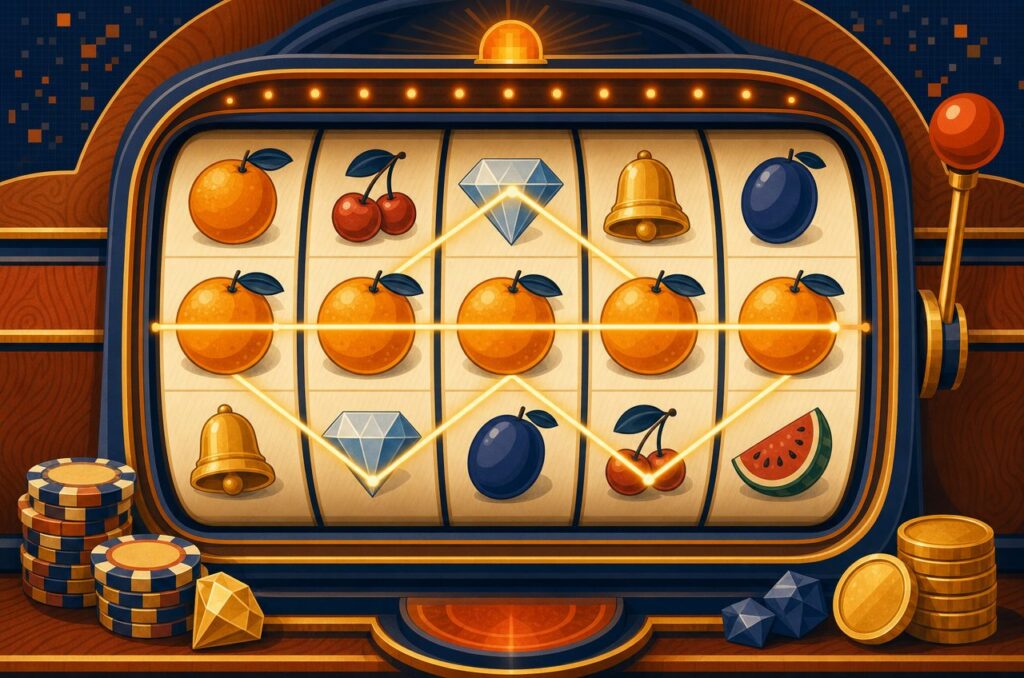
How Slot Paylines and Ways to Win Actually Work
Every slot machine needs a rule for deciding when a spin pays. On classic and many modern games, that rule is the payline: a fixed path across the reels that the game checks for matching symbols. Other games drop the fixed path entirely and use a “ways to win” system instead. Both can sit inside the same casino lobby, and knowing which one you are playing changes how you read the screen.
What a payline actually is
A payline is a defined sequence of positions, one per reel, that the game evaluates after the reels stop. Land enough matching symbols along that path, usually starting from the leftmost reel, and the line pays according to the paytable. Early machines had a single line straight across the middle. Later games added lines that zigzag, step up, or cross diagonally, and a single spin can be checked against dozens of them at once.
The number of paylines matters for cost. On most line-based slots you are betting per line, so a game with twenty lines costs more per spin at the same coin value than a game with ten. The paytable, reachable from a button on the game screen, lists every line and what each symbol combination returns. Reading it before you spin is one of the simpler habits worth keeping, and it pairs well with playing slots with real money at a pace you have already decided on.
How “ways to win” differs
Ways-to-win slots ignore fixed paths. Instead, matching symbols pay as long as they appear on adjacent reels from left to right, regardless of their row. A common layout produces 243 ways, and bigger grids push that into the thousands. You are not betting per line here. The total stake covers the whole grid, which is why the bet structure on these games looks different from a line-based title.
Neither system is inherently more generous. A game’s long-run return is set by its math and its symbol weighting, not by whether it counts lines or ways. More lines or more ways simply means more frequent small hits spread across a spin, which can feel busier without changing the underlying odds. There is a useful run-down of related assumptions in our piece on online gambling facts and misconceptions.
Reading a game before you play
Open the paytable. Check whether the game lists a line count or a ways figure, note the minimum and maximum bet, and see how scatters or wild symbols behave, since those often pay outside the normal path rules. Slots are entertainment, not income. Set a budget you are comfortable losing, treat any return as a bonus rather than a plan, and step away when the session stops being fun. The mechanics are worth understanding for their own sake, and they make the games more interesting to watch unfold.
Leave a Reply