
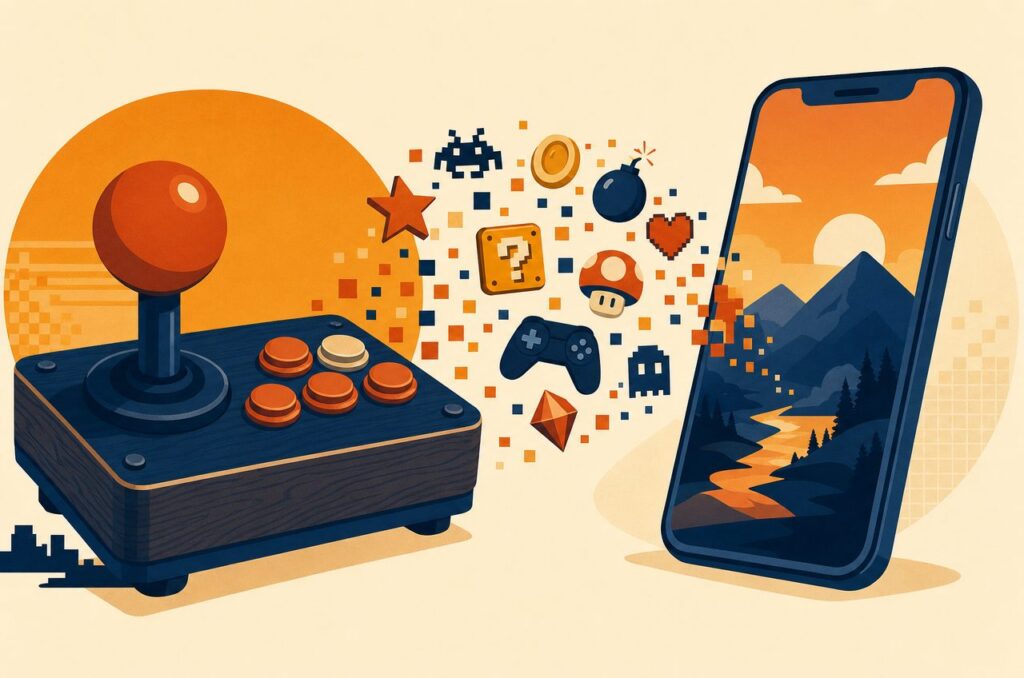
From Arcade Cabinets to Mobile Screens
The arcade was a destination. You went there with a pocket of coins, waited your turn, and played until your quarters ran out. The machine was huge, loud, and rooted to one spot on a sticky floor. Gaming has moved a long way from that model. The same impulse that once pulled people toward a glowing cabinet now lives in a phone that fits in a pocket, and the shift reshaped not just where people play but how they think about playing at all.
The cabinet era and its logic
Arcade machines were built to take money quickly. Difficulty curves were steep on purpose, sessions were short, and the design encouraged you to drop another coin the moment you failed. That structure produced tight, immediate experiences. A game had seconds to grab a passing player and a few minutes to keep them. The cabinet itself was part of the appeal, with custom art, dedicated controls, and sometimes a seat or a steering wheel you could not have at home. Going to play was an event, social by default.
Home consoles loosened the tether
Home systems chipped away at the arcade’s hold. Once a console could approximate the arcade experience in the living room, the reason to leave the house shrank. Players traded the crowd and the cabinet for comfort and unlimited tries. The center of gaming gravity moved indoors, and developers started designing for longer sessions, save files, and stories that unfolded over many hours rather than many coins. The arcade did not vanish, but its role narrowed.
The phone finished the move
Mobile screens completed a long migration. A phone is always present, always connected, and always ready for a thirty-second round while waiting for a bus. Casual play, which the arcade pioneered with simple rules and quick failure, found its natural home here. The genres that thrive on phones often echo old arcade instincts, with short loops, instant restarts, and easy entry. Casino-style and slot games followed the same path, moving from physical machines to touchscreens that anyone can reach in a quiet moment. The audience for short, repeatable play never went away. It just changed devices.
What stayed constant through all of this is the basic craving for a quick, satisfying challenge you can pick up and put down. The arcade answered it with quarters and a queue. The phone answers it with a tap and a notification. Some long-running titles bridge these eras with surprising grace, and the way Age of Empires II remains stronger than ever shows that a good design can survive every change of venue around it. The cabinet is mostly a museum piece now. The instinct it served is more alive than ever, scattered across billions of screens that each hold a little arcade inside.
Leave a Reply